
 Peplink Gold Partner
Why LEO changed connectivity at sea and in the field
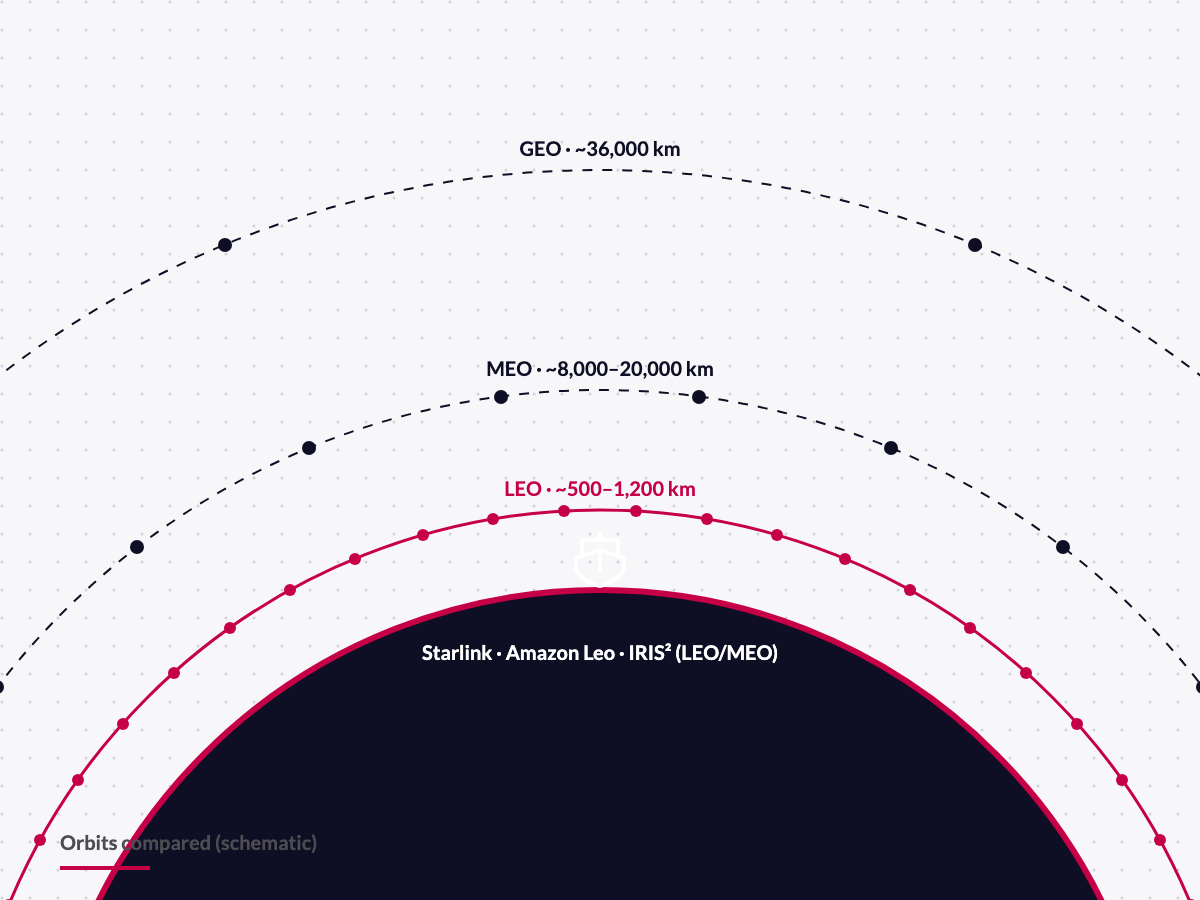
Classic VSAT systems talk to geostationary satellites about 36,000 km up. The round trip takes roughly 600 milliseconds, and bandwidth is scarce and expensive. For a long time that limited video calls, cloud and remote maintenance on board.
LEO constellations fly at 340 to 630 km. Latency drops to a few tens of milliseconds and bandwidth reaches fixed-line levels. Since Starlink covered the oceans, the satellite has moved from fallback to primary link. Amazon Leo and Europe's IRIS² follow.
- GEO/VSAT: around 600 ms latency, predictable but limited bandwidth
- LEO: typically 25 to 60 ms on land, over 100 ms possible on the open ocean
- Starlink available today, Amazon Leo being deployed, IRIS²: first launches and services planned from 2029
- No system replaces the second link: obstruction, weather, maintenance, regulation
Starlink, Amazon Leo and IRIS² compared
As of September 2026. Where operators publish no reliable figures, the table says so.
| Operator | Starlink: SpaceX · Amazon Leo: Amazon · IRIS²: EU/ESA, operated by SpaceRISE (SES, Eutelsat, Hispasat) |
|---|---|
| Orbit / altitude | Starlink: LEO, approx. 340–570 km · Amazon Leo: LEO, 590/610/630 km · IRIS²: higher LEO plus MEO |
| Satellites in orbit / planned | Starlink: >10,000 · Amazon Leo: approx. 400 of 3,236 · IRIS²: 0 of 348 (330 LEO + 18 MEO; including 66 additional LEO satellites for defence, security and emergency services) |
| Service status | Starlink: commercially available · Amazon Leo: enterprise beta since 8 April 2026, first commercial services announced by end of 2026 · IRIS²: first launches by 2029, services progressively from 2029 |
| Target customers | Starlink: residential, business, maritime, mobility, government · Amazon Leo: enterprise, carriers, aviation, maritime, government · IRIS²: governments, defence, emergency services, plus commercial |
| Typical latency | Starlink: 25–60 ms on land, over 100 ms possible at sea (independent measurements) · Amazon Leo: no public field data · IRIS²: not stated |
| Available in DE / EU / at sea | Starlink: yes / yes / yes, gaps in polar regions · Amazon Leo: beta partners in Europe (incl. Vodafone), no date given for business customers in Germany · IRIS²: not yet |
What IRIS² means for critical infrastructure, government and shipping
IRIS² is the EU's third space infrastructure after Galileo and Copernicus: a constellation under European control for governments, defence, emergency services and critical infrastructure. On 7 August 2026 the European Commission and the SpaceRISE consortium (SES, Eutelsat, Hispasat) signed the implementation agreement: 348 satellites in LEO and MEO (330 LEO, 18 MEO, including 66 additional LEO satellites added in August 2026), first launches by 2029, services rolled out progressively from 2029. This matters to critical infrastructure operators because NIS2 demands resilience and supply-chain security: an accredited European link complements Starlink or Amazon Leo as a second, sovereign path. Anyone building today reserves a WAN port for IRIS².
Amazon Leo: status for enterprise and maritime
Amazon renamed Project Kuiper to Amazon Leo in November 2025. As of September 2026 around 400 of 3,236 planned satellites are in orbit. An enterprise beta with partners such as Verizon, AT&T, Vodafone, JetBlue and NASA has been running since 8 April 2026; Amazon has announced first commercial services by the end of 2026; pricing and launch regions are not yet published. For shipping there are reseller agreements with ELCOME and MTN, both covering Europe. Three terminals are announced: Leo Nano (up to 100 Mbps, residential), Leo Pro (up to 400 Mbps) and Leo Ultra (up to 1 Gbps); Pro and Ultra are aimed at vessels and enterprise. Vodafone plans to use Amazon Leo from 2026 to backhaul mobile sites in Germany. As a business you cannot order Amazon Leo in Germany yet. We advise on whether and when it fits your network.
Starlink Business, Maritime and Global Priority
Local Priority covers fixed sites within one country, Global Priority covers vessels, vehicles and worldwide use including international waters. Priority data is favoured when the network is busy; once the allowance is used, service continues with top-up blocks or standard data, while the open ocean requires priority data. Authorised providers offer a Global Priority Unlimited package for IMO-registered cargo and tanker vessels; terms and periods change, so we check the current status for you. At sea the Flat High Performance antenna is used. Limits remain: polar regions, obstruction, congestion in ports, maintenance windows. That is why we never run Starlink alone. For projects and yard periods we also offer Starlink for rent.
Why a single link is never enough
Every constellation has gaps: weather, obstruction, congestion, regulation. We bond LEO with cellular and, where needed, further satellite services.

LEO + 4G/5G with SpeedFusion
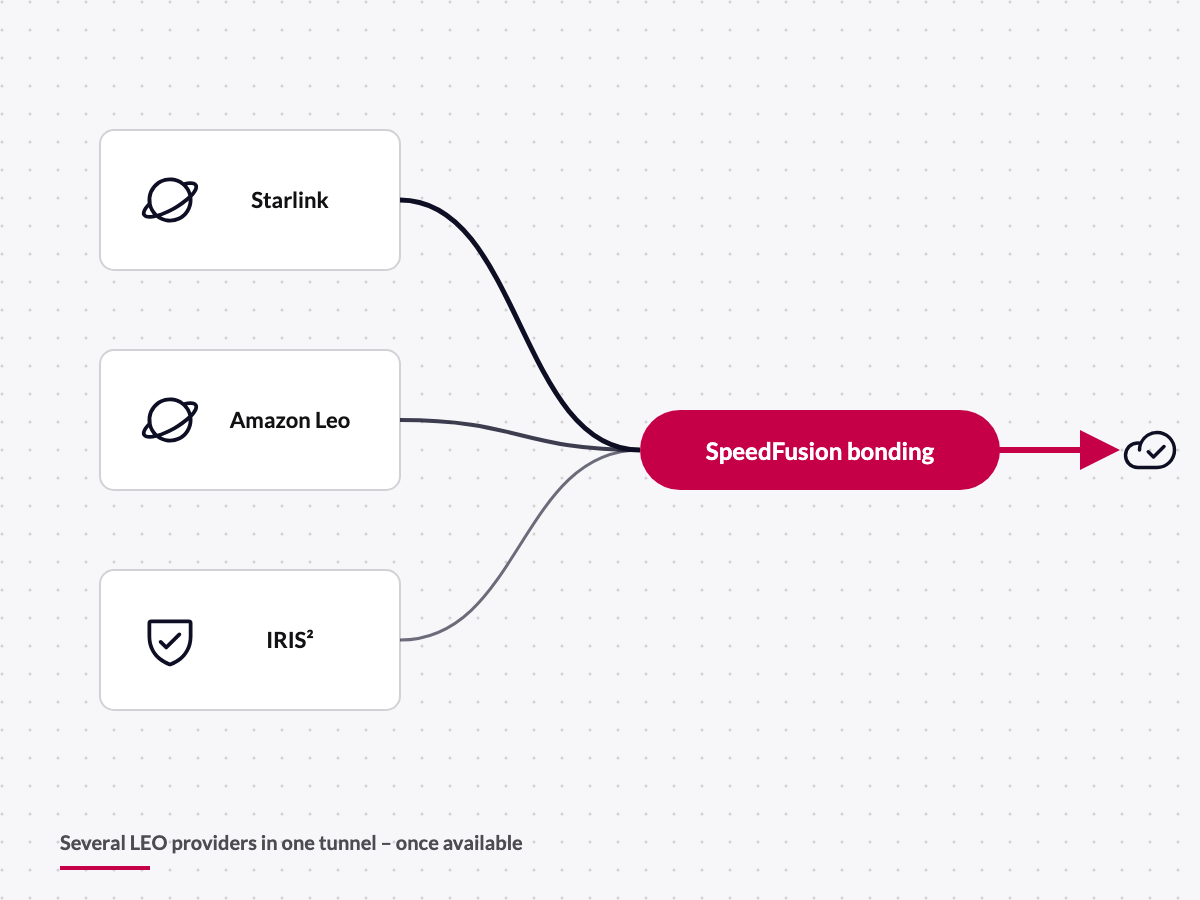
Starlink and cellular run in parallel on one Peplink router. SpeedFusion bonds them, smooths packet loss and fails over without dropping sessions.

VSAT and Iridium as fallback
Where operating area or contracts require it, VSAT stays as a third link. Iridium Certus covers the poles; we integrate Intellian and Kymeta terminals.

SD-WAN with clear rules
Bridge, remote maintenance and telephony get priority, crew Wi-Fi is capped. Rules decide, not chance.

Encryption and segmentation
VPN to head office, separate networks for OT, business and guests, a firewall at the edge. See Cyber Security.

Monitoring across all links
Latency, packet loss and data usage of every link in view. See Monitoring and Alerting.

Ready for Amazon Leo and IRIS²
Every new service is another WAN port. The design stays, the link mix grows.
6G outlook: satellite becomes part of the mobile standard
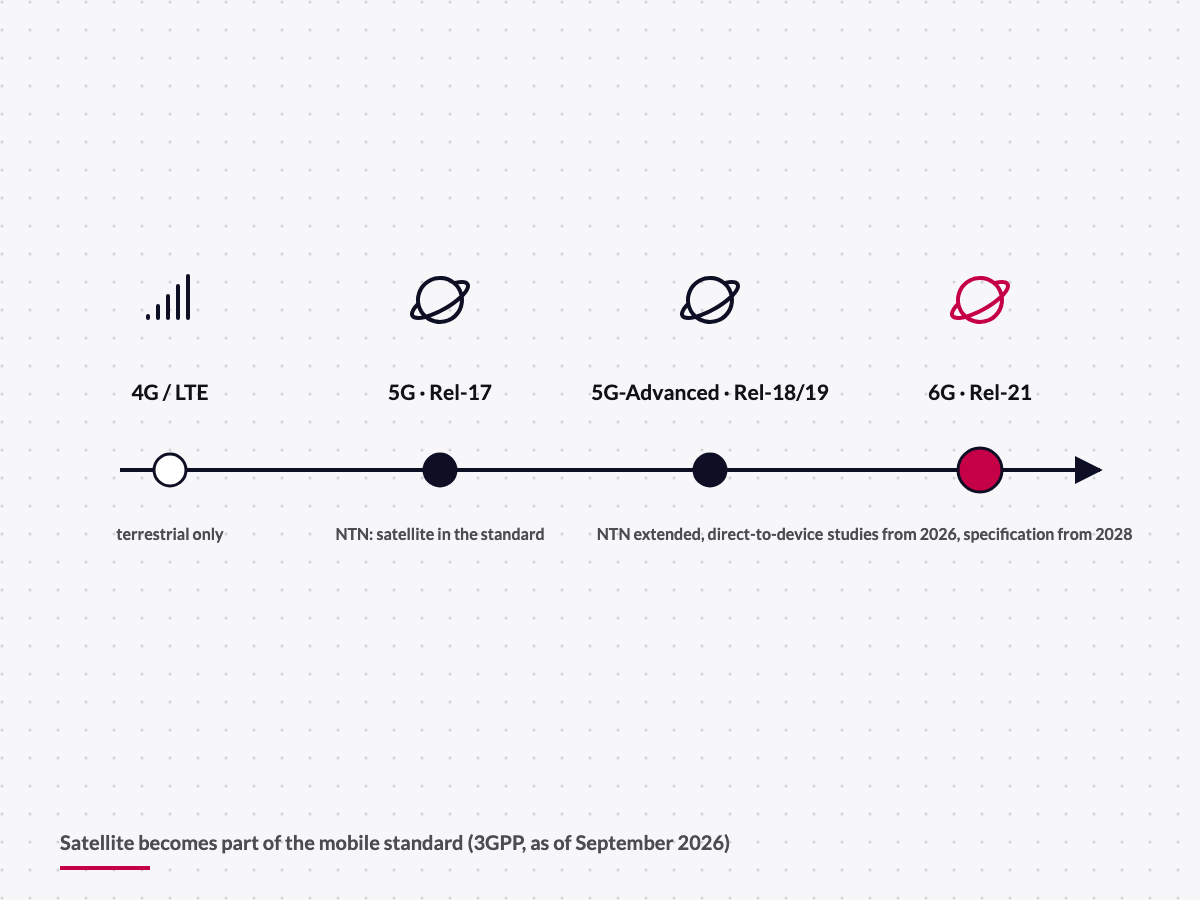
3GPP Release 17 (2022) brought satellites into the 5G standard for the first time as normative non-terrestrial networks (NTN); Release 19 (December 2025) standardised satellites with their own base station. On 10 June 2026 3GPP set the timeline for Release 21, the first 6G specification: stage 1 March 2027, stage 2 June 2028, stage 3 December 2028, protocol freeze March 2029. NTN is part of the architecture from the start, and commercial 6G networks are expected around 2030. The line between cellular and satellite fades step by step; anyone building multi-WAN with 5G and LEO today is prepared. As of September 2026.
What DRYNET delivers, and what it does not
DRYNET is not a Starlink reseller. We source Starlink hardware and service plans through our partner Tototheo; we advise on satellite communication, install and commission the terminals and integrate Starlink into your network. Tototheo Global, headquartered in Cyprus, has delivered Starlink to shipping, enterprise and government customers since January 2023.
Holger Ritter and the team know Amazon Leo and IRIS² in depth; we advise on both and design them in as future links, once available. Peplink builds the network core, where we are a Gold Partner. Cisco, Teltonika, Intellian, Iridium and others are integrated when your project calls for them. Starlink is a trademark of SpaceX.
How you get to a resilient network
Five steps, one point of contact. Prices on request.
Consulting
Which applications must run, what may fail, which rules apply (NIS2, class, flag state)?
Site and operating-area analysis
Starlink and cellular coverage along the route or at the site, obstruction, polar share, data demand.
Network design
Link mix, routers, antenna positions, SpeedFusion profiles, segmentation, plan selection. With spare WAN ports for Amazon Leo and IRIS².
Installation and commissioning
Mounting at pier, yard or site, cable routes, surge protection, test report, handover.
Operation
Monitoring, plan management, firmware, incident handling around the clock. As a managed service or handover to your team.
Where it is used
Wherever fibre is missing or an outage gets expensive.

Vessels and fleets
Starlink Global Priority plus M2SEA cellular near the coast, VSAT as fallback.

Offshore and critical infrastructure
Platforms, wind farms and outstations with redundant links to the control system. See Critical infrastructure & energy and Utilities, water & ports.

Construction sites
Cameras and site management online from day one. See Construction site monitoring.

Media and events
Bonded uplinks for live streams, also for rent. See Media & events.
Frequently asked questions about satellite communication
Is Starlink permitted for critical infrastructure?
There is no general ban. NIS2 requires risk management, redundancy and supply-chain security; Starlink can be one of several links. What counts is end-to-end encryption, segmentation and a second, independent path. The assessment for your facility is made within your regulatory framework; we deliver the technical concept.
When will IRIS² arrive?
According to the European Commission and ESA, first launches are planned by 2029, with operational services rolled out progressively from 2029; no date for full service has been given. The implementation agreement with SpaceRISE was signed on 7 August 2026. As of September 2026.
Can I order Amazon Leo already?
Not in Germany. Amazon Leo has been in an enterprise beta with selected partners since April 2026; first commercial services are announced by the end of 2026; regions and pricing are not yet fixed. We advise as soon as the service is available in your region. As of September 2026.
Does DRYNET sell Starlink?
No. We source hardware and service plans through our partner Tototheo. We advise, install, commission and integrate Starlink into your network, including failover with 4G/5G. For temporary projects we rent Starlink out.
What does a satellite setup cost?
It depends on terminal, plan, number of links and installation effort. We quote on request, itemised by hardware, plans, installation and operation.
How much faster is LEO than VSAT?
In latency roughly a factor of ten: around 600 ms over GEO versus a few tens of milliseconds over LEO. VSAT still makes sense where guaranteed capacity or polar coverage is required.
Does Starlink work in polar regions?
Only to a limited extent. For high latitudes we plan Iridium Certus or VSAT as the fallback layer. We check coverage in the operating-area analysis.
Do I need a Peplink router?
Failover and bonding require a multi-WAN router. Our default is Peplink with SpeedFusion; we integrate Cisco, Teltonika or existing routers as well.
Request a satellite project
Prefer to talk? +49 431 55607040
Related pages
Satellite communication from Kiel
Let's talk about your link mix
Starlink today, Amazon Leo and IRIS² once available, 5G alongside: we design your network so it keeps running when one link fails.